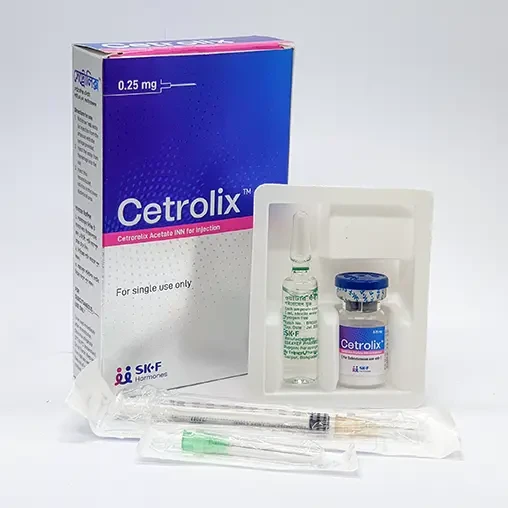
"Cetrorelix Acetate is a synthetic decapeptide with gonadotropin-releasing hormone (GnRH) antagonistic activity. Cetrorelix Acetate blocks the effects of GnRH. GnRH controls the secretion of luteinizing hormone (LH), which induces ovulation during the menstrual cycle. During hormone treatment for ovarian stimulation, premature ovulation may lead to eggs that are not suitable for fertilization. Cetrorelix Acetate blocks such undesirable premature ovulation. GnRH induces the production and release of luteinizing hormone (LH) and follicle stimulating hormone (FSH) from the gonadotropic cells of the anterior pituitary. Due to a positive estradiol (E2) feedback at midcycle, GnRH liberation is enhanced resulting in an LH-surge. This LH-surge induces the ovulation of the dominant follicle, resumption of oocyte meiosis and subsequently luteinization as indicated by rising progesterone levels.
Cetrorelix Acetate competes with natural GnRH for binding to membrane receptors on pituitary cells and thus controls the release of LH and FSH in a dose-dependent manner. The onset of LH suppression is approximately two hours with the 0.25 mg dose. This suppression is maintained by continuous treatment and there is a more pronounced effect on LH than on FSH. An initial release of endogenous gonadotropins has not been detected with Cetrorelix injection, which is consistent with an antagonist effect.
The effects of Cetrorelix Acetate on LH and FSH are reversible after discontinuation of treatment. In women, Cetrorelix Acetate delays the LH-surge, and consequently ovulation, in a dose dependent fashion. FSH levels are not affected at the doses used during controlled ovarian stimulation. A dose of Cetrorelix Acetate 0.25 mg every 24 hours has been shown to maintain the effect."