Medicine

LifePlusHealthcare At Your Fingertips
Doxycycline Hydrochloride
Active ingredient
3 brands we deliver · 50 more sold in Bangladesh
This information is general. Ask your doctor or pharmacist before taking or switching any medicine.
Live prices from our catalogue — add any of them to your cart.
Listed for reference only — no price and no ordering here.
Apdox
100 mg · Capsule
Apex Pharma Ltd.
Aristodox
100 mg · Capsule
Aristopharma Ltd.
Asidox
100 mg · Capsule
Asiatic Laboratories Ltd.
Biocap
100 mg · Capsule
Biopharma Limited
Bpdox
100 mg · Capsule
Bristol Pharmaceuticals Ltd.
Capsidox
100 mg · Capsule
Quality Pharmaceuticals Ltd.
Cosdox
100 mg · Capsule
Cosmo Pharma Laboratories Ltd.
Delacin
100 mg · Capsule
Aexim Pharmaceuticals Ltd.
Difitox
100 mg · Capsule
Al-Madina Pharmaceuticals Ltd.
Dolin
100 mg · Capsule
Union Pharmaceuticals Ltd
Dopac
100 mg · Capsule
Pacific Pharmaceuticals Ltd.
Doxacil
100 mg · Capsule
Square Pharmaceuticals PLC
Doxycycline Hydrochloride is indicated in the following infections caused by susceptible microorganisms:
Respiratory tract infections: Pneumonia, influenza, sinusitis, bronchitis, tonsillitis, tracheitis.
Gastrointestinal tract infections: Cholera, traveler's diarrhea, shigella dysentery, acute intestinal amebiasis.
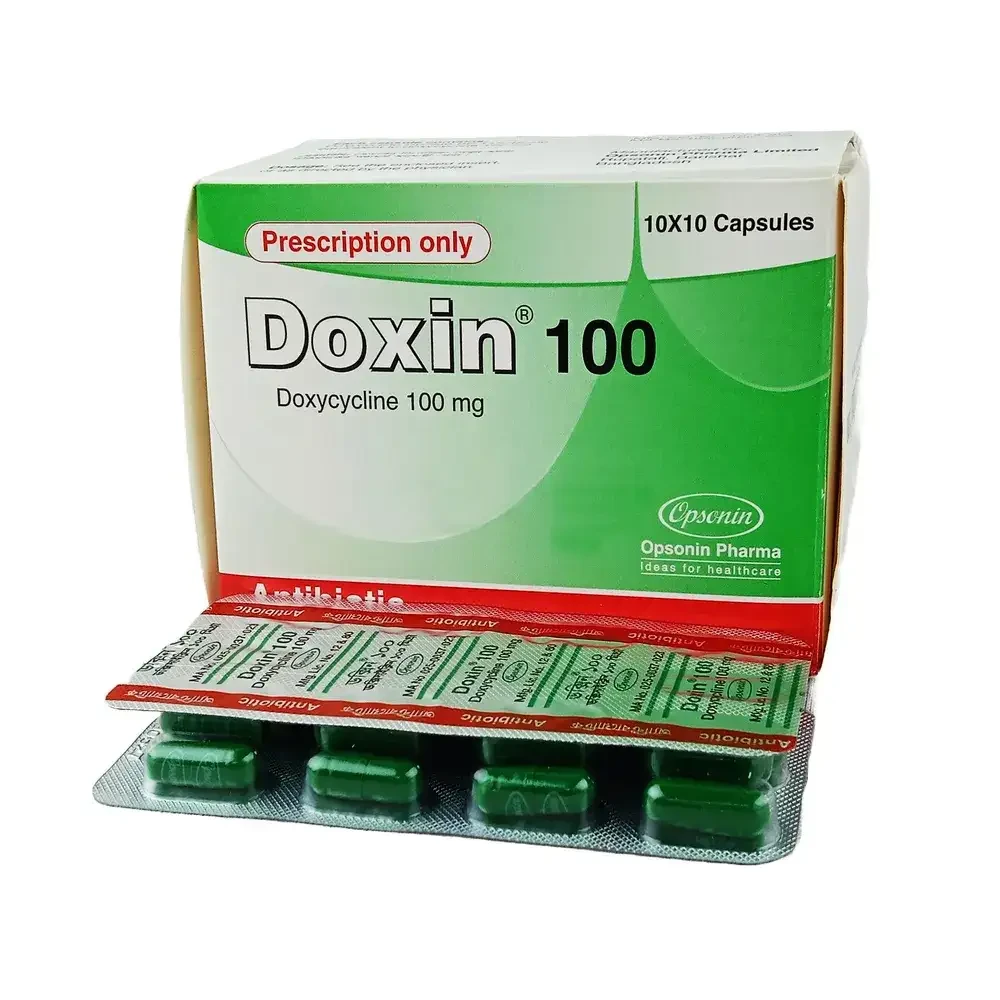
... Read moreDoxin is indicated in the following infections caused by susceptible microorganisms:
Respiratory tract infections: Pneumonia, influenza, sinusitis, bronchitis, tonsillitis, tracheitis.
Gastrointestinal tract infections: Cholera, traveler's diarrhea, shigella dysentery, acute intestinal amebiasis.
Chlamydial infections: Lympho-granuloma venereum, psittacosis, trachoma.
Sexually transmitted diseases: Non gonococcal urethritis, acute pelvic inflammatory disease, uncomplicated urethral and endocervical or rectal infections, gonorrhoea, syphilis, pyelonephritis, cystitis.
Other infections: Impetigo, furunculosis, inclusion conjunctivitis, brucellosis, tularemia, cellulitis, acne and Q-fever.
Doxycycline is contraindicated to the patients who have shown hypersensitivity to any of the tetracyclines. Doxycycline is contraindicated to the children under 8 years of age. It is also contraindicated to pregnant women and to the lactating mothers.
Nausea, vomiting, diarrhoea, skin rashes, hemolytic anaemia, eosinophilia may be reported.
Source: medex.com.bd — View source
Each note below describes one brand at one strength in one form. It is not general guidance for the ingredient.
Doxycycline Hydrochloride is indicated in the following infections caused by susceptible microorganisms:
Respiratory tract infections: Pneumonia, influenza, sinusitis, bronchitis, tonsillitis, tracheitis.
Gastrointestinal tract infections: Cholera, traveler's diarrhea, shigella dysentery, acute intestinal amebiasis.
... Read moreDoxin is indicated in the following infections caused by susceptible microorganisms:
Respiratory tract infections: Pneumonia, influenza, sinusitis, bronchitis, tonsillitis, tracheitis.
Gastrointestinal tract infections: Cholera, traveler's diarrhea, shigella dysentery, acute intestinal amebiasis.
Chlamydial infections: Lympho-granuloma venereum, psittacosis, trachoma.
Sexually transmitted diseases: Non gonococcal urethritis, acute pelvic inflammatory disease, uncomplicated urethral and endocervical or rectal infections, gonorrhoea, syphilis, pyelonephritis, cystitis.
Other infections: Impetigo, furunculosis, inclusion conjunctivitis, brucellosis, tularemia, cellulitis, acne and Q-fever.
Doxycycline Hydrochloride is a highly active broad-spectrum antibiotic of tetracycline group. It is effective against a wide range of Gram-positive and Gram-negative bacteria, spirochete, mycoplasma, rickettsia and mycobacteria. Doxycycline Hydrochloride is used as an alternate to penicillin in the treatment of gonorrhoea and syphilis. Doxycycline Hydrochloride has its main mechanism of action on protein synthesis. Inside the bacterial cell, it inhibits protein synthesis.
Doxycycline Hydrochloride is a semisynthetic tetracycline antibiotic with broad spectrum activity. It is primarily a bacteriostatic antibiotic. It has a similar spectrum of activity to other tetracyclines but in particular is more active against Staphylococcus aureus and Nocardia. The drug is often active against penicillin-resistant strains of Staphylococcus aureus and against strains of those organisms that are resistant to other Tetracyclines. Certain Gram-negative strains of E. coli, Proteus mirabilis and Klebsiella, which are often resistant to Tetracycline, may be sensitive to Doxycycline. In addition, 70-90% of the various anaerobes are sensitive to Doxycycline and Bacteroides fragilis is more likely to be sensitive to Doxycycline than to other tetracyclines.
Doxycycline is active against most strains of Haemophilus influenzaeand is particularly useful for infections with H. ducreyi, Actinomyces, Brucella and Vibrio cholerae. It is also active against Nocardia, Chlamydia, Mycoplasma and a wide range of Rickettsiae. Doxycycline is active against spirochetes such as Borellia recurrentis, Treponema pallidum and Treponema pertenue. It is also active against Plasmodium falciparum.
Usual dose: 200 mg on first day, then 100 mg daily for 7-10 days.
Severe infections (including refractory urinary tract infections): 200 mg daily for 10 days.
Acne: 100 mg daily.
Uncomplicated genital chlamydia, non-gonococcal urethritis: 100 mg twice daily for 7-21 days (14-21 days in pelvic inflammatory disease).
Capsules should be swallowed whole with plenty of fluid during meals while sitting or standing.
Absorption of tetracyclines is impaired by antacid containing aluminium, calcium or magnesium, and iron containing preparation. Absorption of tetracyclines is also impaired by bismuth salicylate. Barbiturates, carbamazepine and phenytoin decrease half-life of doxycycline. Concurrent use of tetracyclines may render oral contraceptive less effective. Patients who are on anticoagulant therapy may require downward adjustment of their anticoagulant dosages. It is advisable to avoid giving tetracyclines in conjunction with penicillin.
Doxycycline is contraindicated to the patients who have shown hypersensitivity to any of the tetracyclines. Doxycycline is contraindicated to the children under 8 years of age. It is also contraindicated to pregnant women and to the lactating mothers.
Nausea, vomiting, diarrhoea, skin rashes, hemolytic anaemia, eosinophilia may be reported.
Doxycycline should be avoided in pregnant women, because of the risk of both staining and effect on bone growth in the foetus. Doxycyclines enter breast milk, and mothers taking these drugs should not breastfeed their child.
The use of drugs of the tetracycline class during tooth development (last half of pregnancy, infancy and childhood to the age of 8 years) may cause permanent discoloration of teeth. Tetracyclines drugs, therefore should not be used in this age group.
Tetracycline group of drugs
Keep all medicines out of reach of children. Store in a cool and dry place, protected from light.
Source: medex.com.bd — View source
Other generics in Antibiotics