Medicine
Square Pharmaceuticals PLC
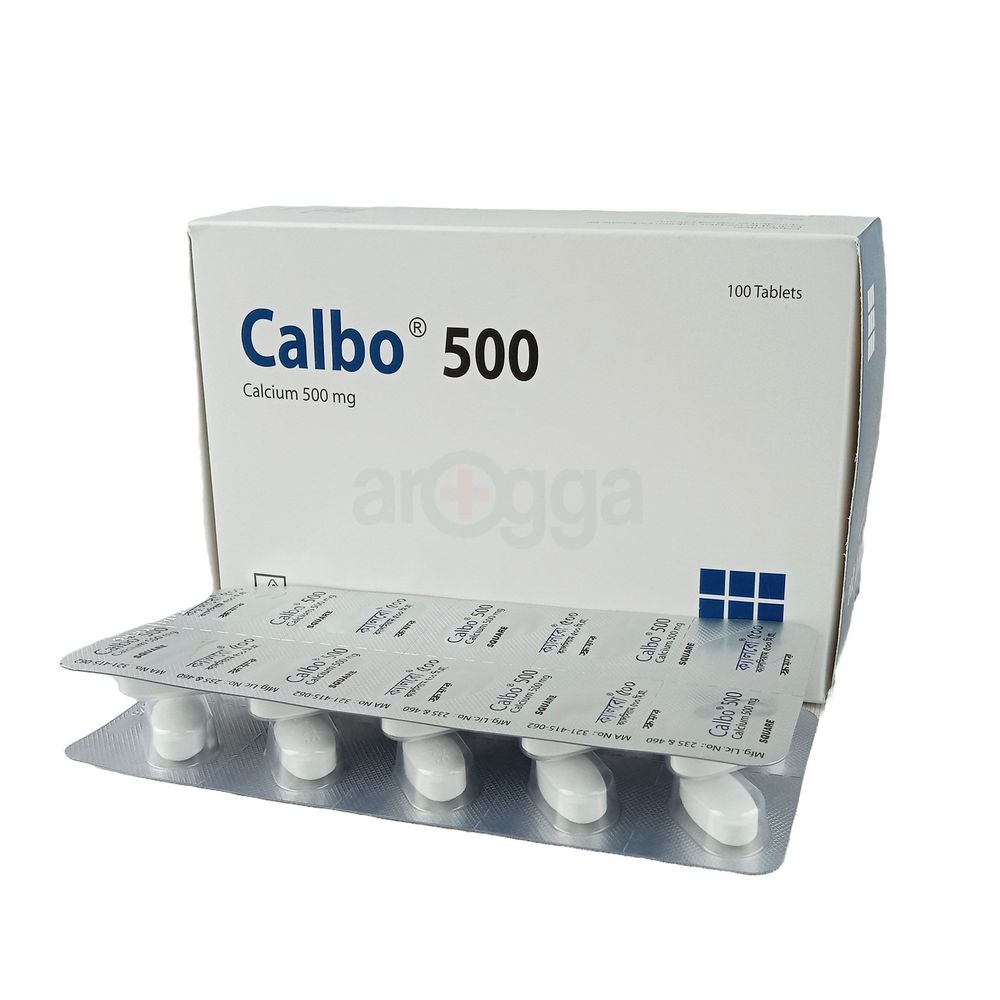
Calbo 500 - Tablet - (500mg)
Calcium Carbonate
- 500 mg
- Tablet
- Strip
৳ 70
In stock

Calcium Carbonate
Active ingredient
1 brands we deliver · 86 more sold in Bangladesh
This information is general. Ask your doctor or pharmacist before taking or switching any medicine.
Live prices from our catalogue — add any of them to your cart.
Square Pharmaceuticals PLC
Calcium Carbonate
In stock
Listed for reference only — no price and no ordering here.
A-Cal
500 mg · Tablet
ACME Laboratories Ltd.
Acical
500 mg · Tablet
ACI Limited
Acical Jr.
250 mg · Tablet
ACI Limited
Ambeecal
500 mg · Tablet
Ambee Pharmaceuticals Ltd.
Aristocal
500 mg · Tablet
Beximco Pharmaceuticals Ltd.
Bonacal
500 mg · Tablet
Marksman Pharmaceuticals Ltd.
Bpcal
500 mg · Tablet
Bristol Pharmaceuticals Ltd.
Cabonate
500 mg · Tablet
Millat Pharmaceuticals Ltd.
Cal
250 mg · Tablet
Pacific Pharmaceuticals Ltd.
Cal
500 mg · Tablet
Pacific Pharmaceuticals Ltd.
Cal-aid
500 mg · Tablet
Ethical Drugs Limited
Calbo Jr
250 mg · Tablet
Square Pharmaceuticals PLC
250 mg or 500 mg tablet : Elemental Calcium Carbonate tablet is used for the treatment or prevention of calcium depletion in patients in whom dietary measures are inadequate. Conditions that may be associated with calcium deficiency include hypoparathyroidism, achlorhydria, chronic diarrhea, vitamin 250 mg or 500 mg tablet : Elemental Calcium Carbonate tablet is used for the treatment or prevention of calcium depletion in patients in whom dietary measures are inadequate. Conditions that may be associated with calcium deficiency include hypoparathyroidism, achlorhydria, chronic diarrhea, vitamin D deficiency, steatorrhea, sprue, pregnancy and lactation, menopause, pancreatitis, renal failure, alkalosis, and hyperphosphataemia. Calcium Carbonate is being used increasingly often to treat hyperphosphataemia in chronic renal failure as well as those on continuous ambulatory peritoneal dialysis (CAPD) and haemodialysis. Many patients are unable to tolerate sufficient doses for complete phosphate control and require additional measures such as stringent dietary phosphate restriction or relatively small doses of aluminium hydroxide. Calcium Carbonate containing preparations can provide short-term relief of dyspeptic systems but are no longer recommended for long-term treatment of peptic ulceration. 1000 mg tablet : Elemental Calcium Carbonate tablet is indicated for the management of conditions associated with hyperidity and for fast relief of acid indigestion, heartburn, sour stomach and upset stomach.
Hypercalcaemia and hyperparathyroidism Hypercalciuria and nephrolithiasis Zollinger-Ellison syndrome Concomitant digoxin therapy (requires careful monitoring of serum calcium level) When hypercalcaemia occurs, discontinuation of the drug is usually sufficient to return serum calcium concentrations to normal. Calcium salts should be used cautiously in patients with sarcoidosis, renal or cardiac disease, and in patients receiving cardiac glycosides.
Orally administered Calcium Carbonate may be irritating to the GI tract. It may also cause constipation. Hypercalcaemia is rarely produced by administration of calcium alone, but may occur when large doses are given to patients with chronic renal failure.
Source: medex.com.bd — View source
Each note below describes one brand at one strength in one form. It is not general guidance for the ingredient.
250 mg or 500 mg tablet : Elemental A-Cal tablet is used for the treatment or prevention of calcium depletion in patients in whom dietary measures are inadequate. Conditions that may be associated with calcium deficiency include hypoparathyroidism, achlorhydria, chronic diarrhea, vitamin 250 mg or 500 mg tablet : Elemental A-Cal tablet is used for the treatment or prevention of calcium depletion in patients in whom dietary measures are inadequate. Conditions that may be associated with calcium deficiency include hypoparathyroidism, achlorhydria, chronic diarrhea, vitamin D deficiency, steatorrhea, sprue, pregnancy and lactation, menopause, pancreatitis, renal failure, alkalosis, and hyperphosphataemia. A-Cal is being used increasingly often to treat hyperphosphataemia in chronic renal failure as well as those on continuous ambulatory peritoneal dialysis (CAPD) and haemodialysis. Many patients are unable to tolerate sufficient doses for complete phosphate control and require additional measures such as stringent dietary phosphate restriction or relatively small doses of aluminium hydroxide. A-Cal containing preparations can provide short-term relief of dyspeptic systems but are no longer recommended for long-term treatment of peptic ulceration. 1000 mg tablet : Elemental A-Cal tablet is indicated for the management of conditions associated with hyperidity and for fast relief of acid indigestion, heartburn, sour stomach and upset stomach.
250 mg or 500 mg tablet : Calcium Carbonate is always used orally and when used as an antacid the recommended doses for adults are equivalent to 540-2000 mg Calcium Carbonate per day, doses for children being half of those for adults. As a dietary supplement, such as for the prevention of osteoporosis, 1250-3750 mg Calcium Carbonate (500-1500 mg calcium) daily is recommended in general, but again this will need to be tailored to the individual patient depending on any specific disease such as Calcium deficiency, malabsorption or parathyroid function. In pregnancy and lactation the recommended daily dose of calcium is 1200-1500 mg. In chronic renal failure the doses used vary from 2.5-9.0 gm Calcium Carbonate per day and need to be adjusted according to the individual patient. To maximize effective phosphate binding in this context the Calcium Carbonate should be given with meals. 1000 mg tablet : 2000-3000 mg tablet when symptoms occur; may be repeated hourly if needed or as directed by the physician.
Hypercalcaemia and hyperparathyroidism Hypercalciuria and nephrolithiasis Zollinger-Ellison syndrome Concomitant digoxin therapy (requires careful monitoring of serum calcium level) When hypercalcaemia occurs, discontinuation of the drug is usually sufficient to return serum calcium concentrations to normal. Calcium salts should be used cautiously in patients with sarcoidosis, renal or cardiac disease, and in patients receiving cardiac glycosides.
Orally administered A-Cal may be irritating to the GI tract. It may also cause constipation. Hypercalcaemia is rarely produced by administration of calcium alone, but may occur when large doses are given to patients with chronic renal failure.
A-Cal may enhance the cardiac effects of digoxin and other cardiac glycosides, if systemic hypercalcaemia occurs. A-Cal may interfere with the absorption of concomitantly administered tetracycline preparations and in chronic renal failure modification of vitamin D therapy may be required to avoid hypercalcaemia when A-Cal is used as the primary phosphate binder.
Calcium containing drugs have been widely used in pregnancy by way of oral calcium supplementation or antacid therapy. Calcium Carbonate can be used in lactating women too.
Store in a cool, dry place in controlled room temperature.
Source: medex.com.bd — View source
Other generics in Vitamins & Supplements